Case Study
Beyond Meat’s Risk Quotient Debuted Well Below Industry Peers and Eroded Further Before Stock Crashed 97%
Case Study
NYSE: BYND
Beyond Meat (NASDAQ: BYND), a leading name in plant-based meats, was championed by Wall Street as the future of food innovation. However, despite clear disclosures of regulatory risks—particularly the need for U.S. Food and Drug Administration (FDA) approval and strict compliance requirements—the market consistently overlooked these warnings.
When regulatory threats materialized in the form of lawsuits and ingredient controversies, Beyond Meat’s stock plummeted 97% from its post-IPO highs, illustrating the devastating impact of ignoring explicit risk factors.
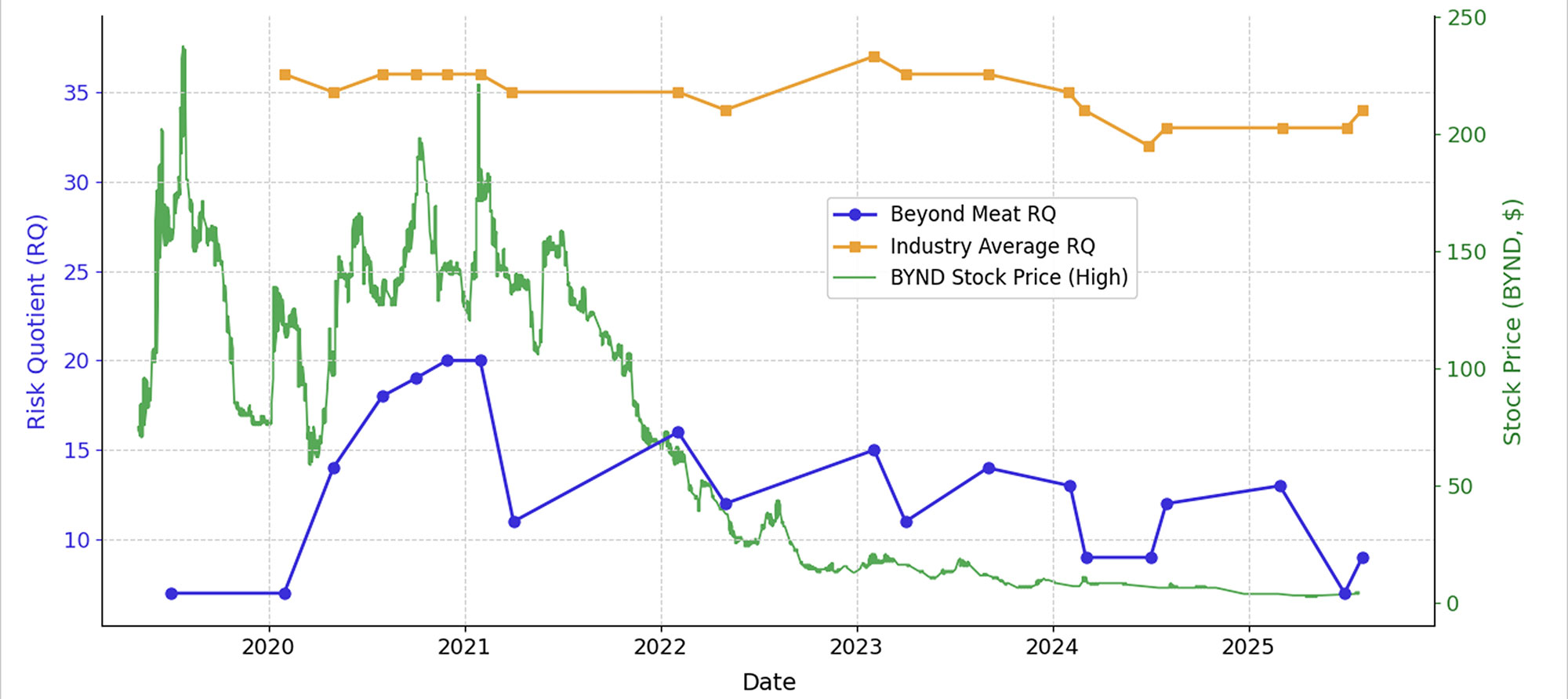
At IPO in May 2019, Beyond Meat’s RQ debuted at 7, 82% below the industry average. As the stock traded near its IPO peak of $239, the RQ began to drop, sinking 45% from January to April 2021 due to cautionary disclosures from management. The stock followed six months later, steadily declining 87% from June 2021 to June 2022. Today, BYND consistently trades in the low single digits, down over 97% from its post-IPO highs.
From its 2019 10-K (filed March 19, 2020), Beyond Meat acknowledged the extensive oversight imposed by the FDA and other agencies over its product’s composition, labeling, manufacturing processes, and food safety:
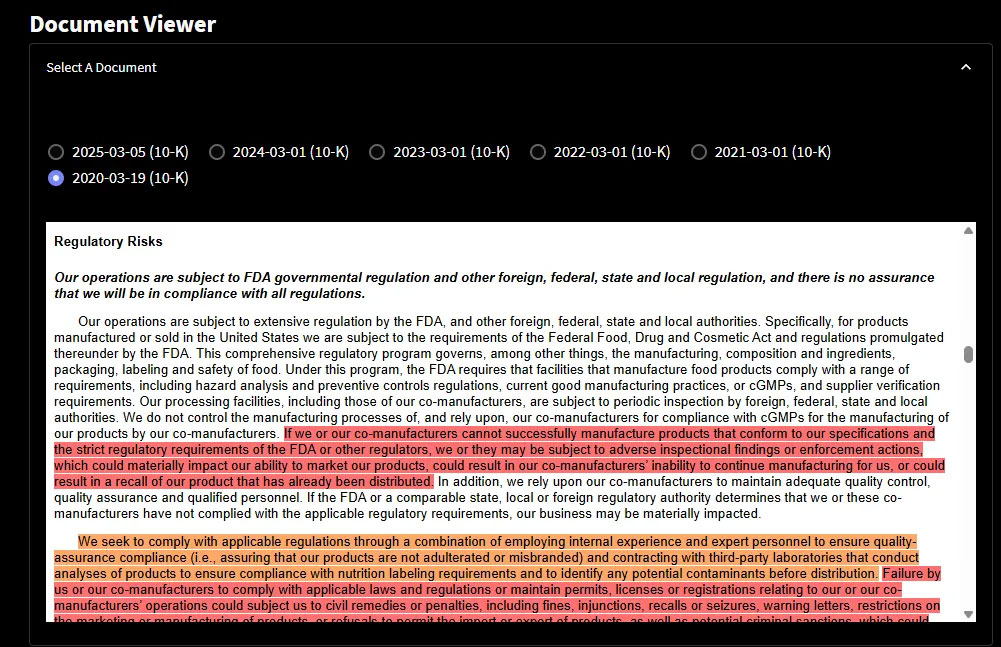
FDA Regulation: “If we or our co-manufacturers cannot successfully manufacture products that conform to our specifications and the strict regulatory requirements of the FDA or other regulators, we may be subject to adverse inspectional findings or enforcement actions, which could materially impact our ability to market our products, could result in our co-manufacturers’ inability to continue manufacturing for us, or could result in a recall of our product that has already been distributed.”
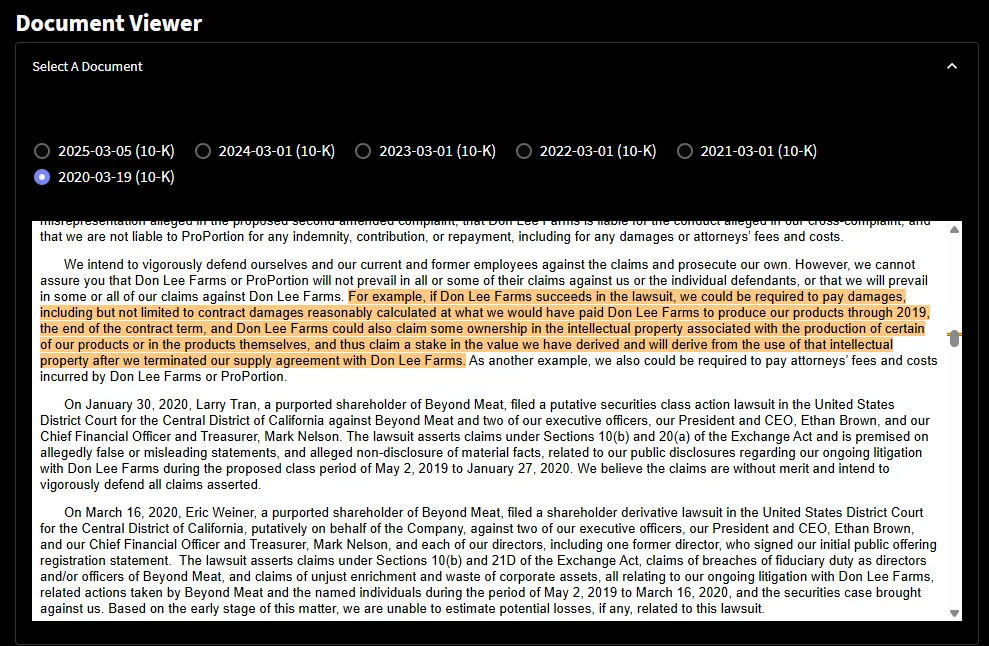
Litigation Proceedings: “For example, if Don Lee Farms succeeds in the lawsuit, we could be required to pay damages, including but not limited to contract damages reasonably calculated at what we would have paid Don Lee Farms to produce our products through 2019, the end of the contract term, and Don Lee Farms could also claim some ownership in the intellectual property associated with the production of certain of our products or in the products themselves, and thus claim a stake in the value we have derived and will derive from the use of that intellectual property after we terminated our supply agreement with Don Lee Farms.”
Later business reporting noted that Beyond Meat faced multiple federal lawsuits originating from supplier disputes and claims of misleading marketing practices, conditions THEIA’s RRX™ platform had highlighted in the company’s 2020 financial disclosures. According to a 2022 Food Beverage Insider article, two lawsuits specifically accused Beyond Meat of:
“Two recently filed lawsuits allege the producer of plant-based meat alternatives made misleading claims regarding its products’ protein content.”
“The first case … claimed Beyond Meat overstated the protein content of its products. According to the suit, the company purportedly misrepresented the nature and quality of its products while aware it was not following federal regulations for appropriate testing methods to determine protein content.”
“A similar federal lawsuit … alleged that Beyond Meat reportedly overstates the protein content of its products by up to 30%, and challenged the company’s claim that its products are free from ‘synthetic’ ingredients.” Citation: foodbeverageinsider.com
THEIA’s RRX™ platform consistently identified deteriorating Risk Quotient (RQ) scores for Beyond Meat, confirming mounting risk factors even as market optimism persisted:
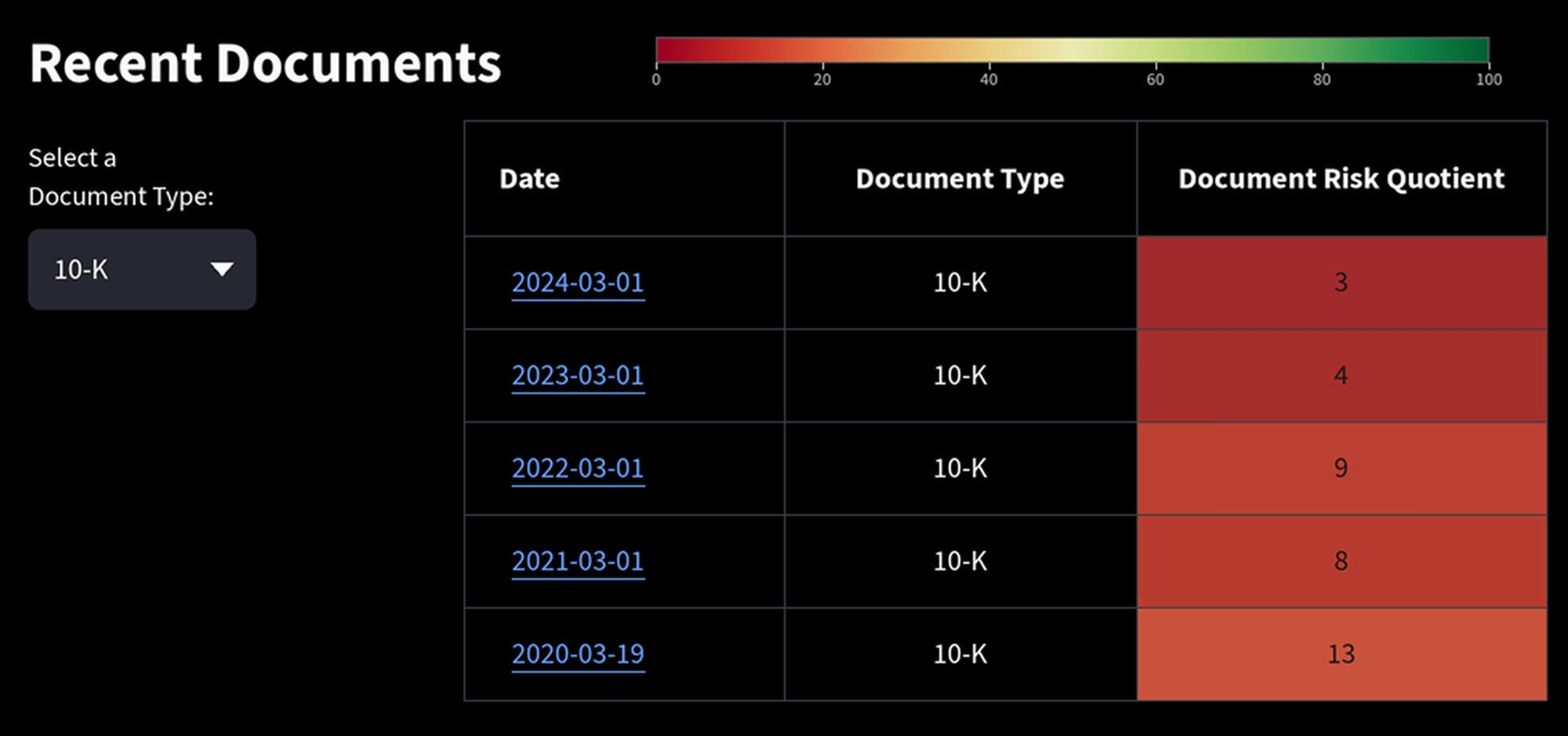
Investor inattention to these early warning signs proved costly.
Beyond Meat attempted to address the growing regulatory challenges by spending over $100K of scarce cash resources on lobbying, seeking proactive mitigation. However, these efforts failed to alter the risk trajectory.
Shares fell 97% off their post-IPO highs, wiped out by legal disputes and operational missteps.
Beyond Meat’s share price steadily eroded as quarterly earnings repeatedly disappointed, revenue growth slowed, and losses mounted. Institutional investors abandoned the stock, accelerating the price collapse and leaving remaining shareholders with substantial losses.
The dramatic decline destroyed billions in market value, as fundamental risks—overlooked amidst hype—triggered a sustained sell-off and exposed investors to catastrophic downside. Citation: ig.com
The Beyond Meat collapse illustrates the necessity for robust, data-driven risk assessments. THEIA’s RRX platform offered advance warning before litigation and regulatory failures dominated headlines. Had stakeholders leveraged these insights, many could have minimized exposure to one of the most dramatic share price meltdowns in recent consumer food history.
Let us show you how Theia can surface disclosure risk across the companies, sectors, or portfolios you care about.
