Case Study
Estee Lauder’s Declining Risk Quotient Captured Long-Burning Structural Risks Before Stock Collapsed Over 75% After Peak
Case Study
NYSE: EL
THEIA’s patented Risk Quotient flagged Estée Lauder as riskier than peers, capturing a long-burn narrative that was downplayed in filings but eventually manifested in litigation and market performance. This case underscores how a company’s Risk Quotient or RQ provides an objective early-warning system and counterweight to market sentiment.
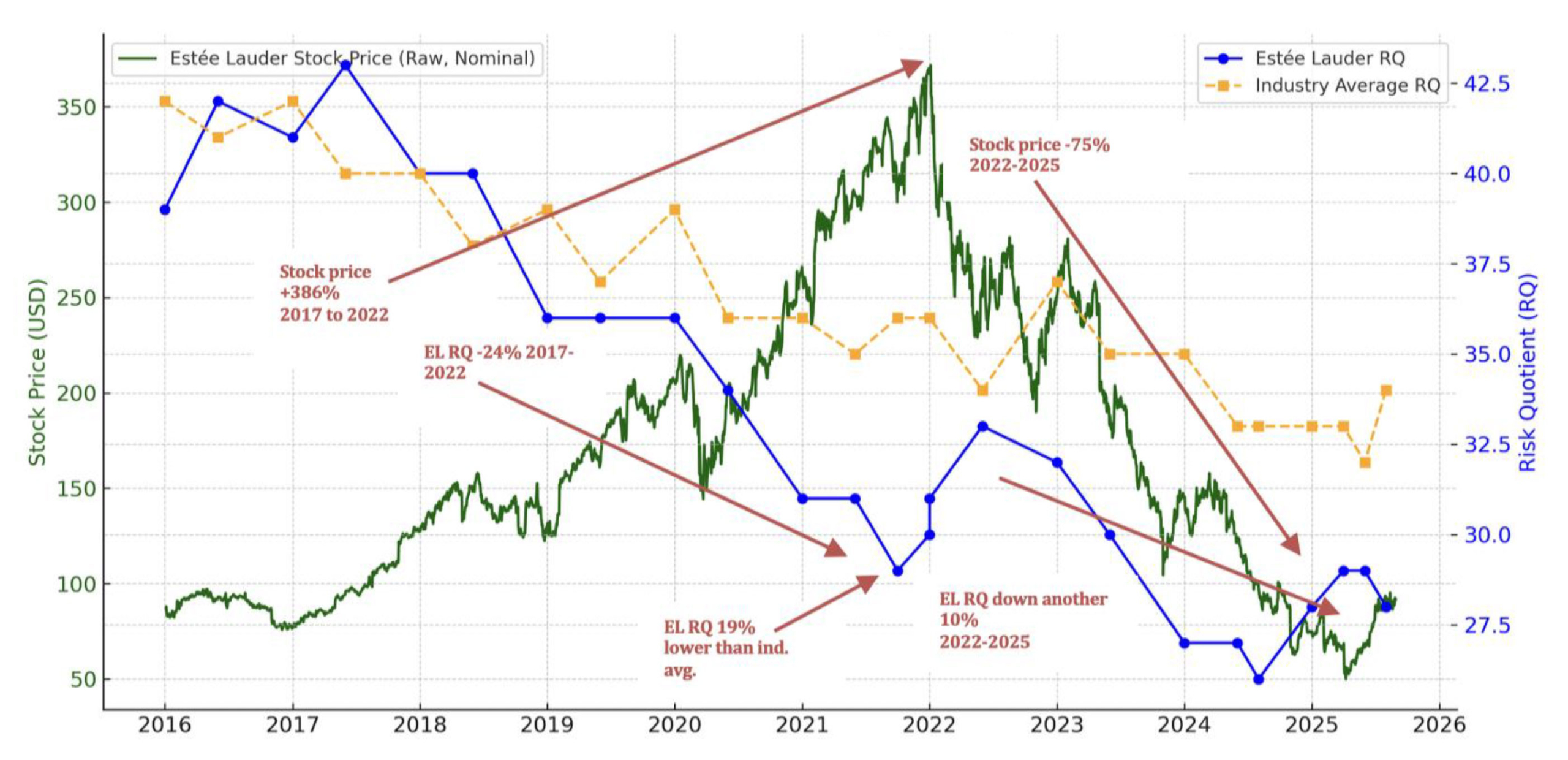
As shown above, Estée Lauder’s RQ steadily deteriorated over multiple years, lagging its industry peers. THEIA’s algorithm contextualized unfolding structural risks (China dependence, daigou channel exposure, and litigation vulnerability), reflected in the worsening RQ, well before the market reacted. In fact, the stock held up for years, supported by brand momentum and favorable investor sentiment, before collapsing when these structural risks materialized.
Between 2017 and early 2022, Estée Lauder’s stock price surged nearly 400%, climbing from ~$76 to over $370 per share. Over the same period, however, the company’s RQ declined by 24%, dropping from 41 to 31. This divergence captures the disconnect between market optimism — driven by strong brand momentum and investor enthusiasm — and the mounting governance and regulatory risks flagged by the RQ. While investors rewarded the company with an aggressive multiple expansion, the RQ signaled underlying vulnerabilities were deepening.
From its January 2022 peak to today, Estée Lauder’s stock price collapsed by more than 75%, erasing nearly all of the gains of the prior five years. During this same period, the RQ fell another 10%, from 31 to 28, reflecting continued deterioration in governance and risk factors. Here, unlike the earlier period, both the market and the RQ moved in the same direction — validating the risk trajectory that had already been flashing warning signals well before the stock price reversal. Notably, Estée Lauder’s SEC filings had flagged potential daigou channel risks prior to lawsuits being filed (subsequent litigation alleged that these risks had materialized in ways not fully conveyed to investors).
Across both phases, the RQ provided an early, objective counterweight to market sentiment, underscoring its utility as a forward-looking governance risk signal.
The Surge Jan 2017 to Jan 2022
| Metric | Estée Lauder RQ | Stock Price (Raw, Nominal) |
|---|---|---|
| Start (Jan 2017) | 41 | $76.49 |
| End/Peak (Jan 2022) | 31 | $371.86 |
| Absolute Change | -10 points | +$295.37 |
| % Change | -24.4% | +386% |
The Fall Jan 2022 to Aug 2025
| Metric | Estée Lauder RQ | Stock Price (Raw, Nominal) |
|---|---|---|
| Start (Jan 2022) | 31 | $371.86 |
| Current (Aug 2025) | 28 | $91.73 |
| Absolute Change | -3 points | -$280.13 |
| % Change | -9.7% | -75.3% |
Let us show you how Theia can surface disclosure risk across the companies, sectors, or portfolios you care about.
